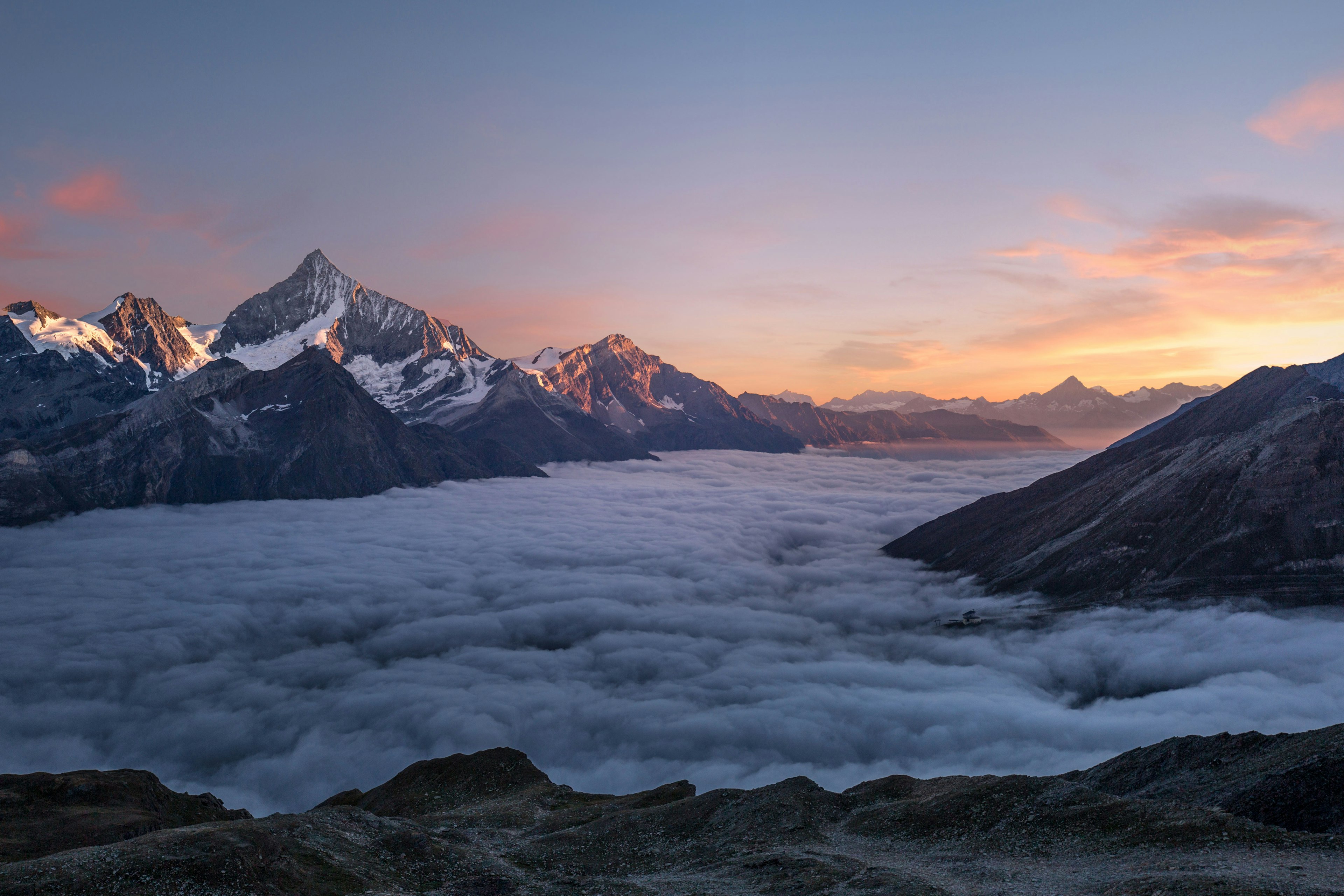

Cloud.
Job
The slow atmospheric passage. A layer moving across many seconds, the page's one continuous motion.
Refusal
Not quick; not registered as an event; never the figure of the page.
Chapter II
Motion is how a published surface acts in time. This chapter names the small vocabulary of motions the institution permits, argues why most of that vocabulary is stillness, and walks each motion with figures from the live site.
The disciplines of a page are, for the most part, spatial. Materials, typography, and composition each turn on a question of space: what the surface is made of, and where on it a thing should sit. The vocabulary is spatial through and through: composition, placement, figure and ground, negative space, every term naming a where and none of them a when. But a page is not met in space alone. It is also met in time. It arrives, it holds while the reader works down through it, and in a few places it answers the attention the reader brings to it. Motion is the discipline of that second dimension, the same standard of restraint translated out of space and into time.
A page acts in time, and time forgives less than space. A static ornament waits to be looked at, and a reader can leave it unread. An ornament that moves spends the reader's attention on its own schedule, and cannot be left unread while it moves. So the institution holds motion to one rule, and holds it strictly: a motion is permitted only when it refers to a physical thing the reader already knows how to read. A settling, an arrival, a coming to rest. A motion with no such referent is not a small indulgence; it is the institution acting without a reason, in the dimension where a reader cannot look away.
The discipline is old, and its clearest statement comes from animation. Thomas and Johnston, setting down the principles of Disney animation, named what makes a moving thing read as alive: weight, the slow start and slow close of a real mass, the follow-through of a body that does not arrest all at once (Thomas and Johnston, 1981). Their argument is that motion is believed when it obeys the physics the eye already carries. The institution takes the same position. A motion is admitted when the eye can check it against the world, and refused when it cannot.
The corollary is the chapter's first claim, and the one most easily mistaken. Motion is mostly the decision not to move. A surface that moved everything would tell the reader nothing, because attention is drawn by contrast and contrast needs a still field to register against. The motions the institution permits are a small set of rationed exceptions to a stillness that is itself composed. Stillness is not the absence of motion design. It is the larger half of it.
The institution permits five motions, and no surface moves in a way the five do not name: a passage, an arrival, a settling, a proof gesture, and a stillness. Everything that moves on a Vanta Crest surface moves as one of these, and the discipline is to admit no sixth.
A small motion vocabulary is harder to hold than a large one, in the way a small material or typographic vocabulary is harder. Each occasion offers a reason for one more motion: a transition to ease a change, a flourish to mark an arrival, a movement to acknowledge a state. The discipline argued here is the opposite path. The vocabulary is held to five, each tied to a physical referent, and a surface that asks for a new motion is read as a surface that has not yet found its composition.
Holding the vocabulary small is possible because stillness carries most of the work, and stillness is composed rather than left over. Choreography states it directly: Humphrey describes the making of a dance as the design of its phrases and its rests together, the still moment shaped with the same care as the moving one (Humphrey, 1959). Music states it more plainly still. The rest is a written mark, not an empty space, and a passage is shaped by where the sound stops as much as by where it sounds (Cooper and Meyer, 1960). The institution composes its stillness the same way. A page's structural elements are held still on purpose, so that its few moving elements carry meaning when they move.
A small motion vocabulary is also auditable, in the sense the Materials chapter gives the word. Five motions, each with a named referent; a surface that moves outside the five is legible as an error. A page that animated freely could not be held to anything, because there would be no standard for a motion to depart from. Restraint is the precondition for accountability here, as it is across the paper.
The institution holds five motions. Each has a job; each has a refusal; each refers to something physical the reader can check it against.
The slow atmospheric passage. A layer moving across many seconds, the page's one continuous motion.
Not quick; not registered as an event; never the figure of the page.
The arrival. The surface coming into focus once, on the reader's first sight of it.
Not repeated; not performed by the furniture of a page; one gesture, made once.
The settle. A surface coming to rest the way water finds its level, fast and then slowing and then still.
Not a snap; not a motion the reader waits on; a settling, not an entrance.
The proof gesture. A figure settling as a posting clears, the surface showing that what it presents has resolved.
Not delight; not decoration; a gesture that means the figure reconciled.
Stillness. The structural elements of a page do not move. The largest part of the vocabulary.
Not inertness; not the absence of design; a held decision that what should hold, holds.
The vocabulary is closed. A sixth motion would have to name its physical referent and win its place against the five. The discipline is that the argument is hard to win.
Cloud is the slow atmospheric passage, a layer moving across the photograph over many seconds. It is the one motion on a Vanta Crest surface that is continuous; every other motion is a discrete event or a stillness. The passage is slow enough that the reader does not watch it move. They register, without attending to it, that the page is a living environment rather than a fixed image.
The referent is literal. Cloud passes because cloud passes, on the alpine ground the photograph already holds. The motion does not have to be learned; the reader has watched cloud move over a mountain, and the page asks nothing more of them than to recognise it. This is the chapter's rule at its simplest: the motion names a thing the eye already knows, and is believed without effort.
Cloud also carries a relationship the reader can see in a single frame. In the photograph that grounds every page, the cloud passes and the mountain holds, at the same time, in the same image. The page's own ground is a standing statement of the motion vocabulary: atmosphere moves, structure does not. A reader who looks at the photograph has been shown the chapter's argument before reading a word of it.
The slow atmospheric passage, crossing without end.
The structure beneath it, held still.
Air is the arrival. On the reader's first sight of a page, the photograph and the opening settle into focus together, once, over something near a second and a half. It is the institution coming into view. After it, the page is simply present; the arrival is not performed again.
The restraint in air motion is in what does not perform it. The navigation, the structure, the furniture of a page do not arrive; they are there from the first frame, because furniture has no physical referent for appearing and a motion without a referent is refused. Only the institution itself, the photograph and the page's opening, makes the arrival gesture. The strongest motion the page has is spent once, on the one thing it is for.
A reader who moves from one page to the next is not arrived at again. The institution introduces itself a single time and then holds still, where a surface anxious to be noticed would re-perform its entrance at every turn. The single arrival is the motion form of a settled thing: it has arrived, and it does not need to keep arriving.
The institution comes into view once, then holds.
Glass is the settle. A surface comes to rest the way water finds its level: it moves quickly at first, then slows, then holds. The curve is a deceleration, and the deceleration is the referent; the reader has watched water settle and reads the same motion here without being told what it is.
The settle is reserved for the surfaces where the reader's attention is the subject. The framed plates that open the paper's pages settle on arrival; a surface the reader brings their attention to settles toward them and then returns to stillness. This is a motion of acknowledgement, not of display. It is initiated by the reader's arrival or the reader's attention, and it answers; it is not a motion the institution performs at the reader unprompted. The distinction is the whole of it. Acknowledgement composes with the reader; performance speaks over them.
Glass holds its motion to the smallest amount that still reads. A settle the reader had to wait on would have become an entrance, and an entrance asks the reader to watch. The institution's settle is brief and quiet enough that the reader feels the surface come to rest without having attended to the resting. Motion, here, is felt and not watched.
Quick at first, then slowing, then still.
Specimen is the proof gesture. When a figure of financial logic resolves on the page, it settles, briefly, the way a posting clears in a ledger. The motion is short and attended, and it is the one motion in the vocabulary drawn not from the alpine register but from the institution's own working domain.
The settle is a claim. A figure that snapped into place would read as an interface drawing itself; a figure that settles reads as a posting that has cleared, a number that has resolved against real logic. The motion says, without a word, that what is shown reconciles. It is evidence in the form of movement, and like all of the institution's evidence it is offered to be checked: the figure that settles is the same figure the reader can open and audit.
Specimen motion is where this chapter meets the two before it. The Materials chapter names the specimen as the institution's proof unit; the Typography chapter sets its figures in tabular numerals so a reader can audit them; the settle is the motion that completes the gesture. A reader watching a specimen resolve is reading materials, typography, and motion at once, composed into a single act of proof.
Mountain is stillness, and stillness is the largest part of the motion vocabulary. The structural elements of a page do not move: the photograph holds across the viewport, the headings hold, the navigation holds. The entry in the vocabulary that reads as no motion is a composed decision, not the absence of one.
Stillness is, for a financial institution, a form of trust. The things that must never move are the balance, the record, the figure that has reconciled; a surface whose structure shifted under the reader would unsettle exactly where the institution most needs to be steady. The institution holds its structure still so that the reader can rely on it, and moves only the few elements whose movement carries meaning. The photograph, the most constant material in the catalogue, is also the stillest; the reader is held, on every page, by something that does not move.
Stillness is also what lets the rest of the vocabulary mean anything. A passage registers as atmosphere only against a structure that holds; a settle registers as acknowledgement only against a page that is otherwise at rest. Mountain motion is not the background to the other four. It is the field they are read against, and without it they would be noise.
The vocabulary is defined as much by what it refuses as by what it permits. Three refusals carry the most weight.
The institution refuses motion without a physical referent. A transition placed to ease a change, a movement added because a surface felt static, an animation that performs liveness: each of these moves without a thing in the world for the eye to check it against, and motion the eye cannot check is decoration. The five motions each name a referent; a sixth would have to do the same, and the discipline is to refuse it until it can.
The institution refuses motion that performs. Motion the institution begins unprompted, a surface that draws itself at the reader, an arrival re-performed at every page: each speaks over the reader rather than with them. The permitted motions are either continuous and atmospheric, or they answer the reader's own arrival or attention. The institution acts in time; it does not perform in it.
The institution refuses to make motion load-bearing. A reader who has asked their device for reduced motion meets the page with the whole vocabulary disabled, and the page must remain complete: every argument intact, every figure legible, nothing of the institution's meaning lost. A page whose sense broke without its motion would have smuggled meaning into decoration. The page composed for stillness is the proof that the motion was never carrying the meaning; it was only ever acknowledging the reader, and acknowledgement can be withdrawn without cost.
Motion does not stand on its own. Materials decide what is allowed to move: the photograph holds, glass settles, the responsive surface answers, and the motion of each is a property of the material it belongs to. Typography sets the constraint that motion must not disturb the line a reader is reading. Composition, in Chapter IV, places motion within the reading rhythm of the page. Voice, in Chapter V, depends on motion staying quiet, since a voice carried on theatrical motion stops being believed. Discipline, in Chapter VI, names the refusal of unreferenced motion as one instance of the institution's larger restraint.
This chapter's own page acts as the chapter describes. It arrives once and then holds; its framed plates settle as they come to rest; nothing on it moves without a referent, and read with motion disabled it loses none of its argument. A chapter on motion that performed for the reader would have refuted itself in the reading. This one is built to be checked, and it holds still enough to be.